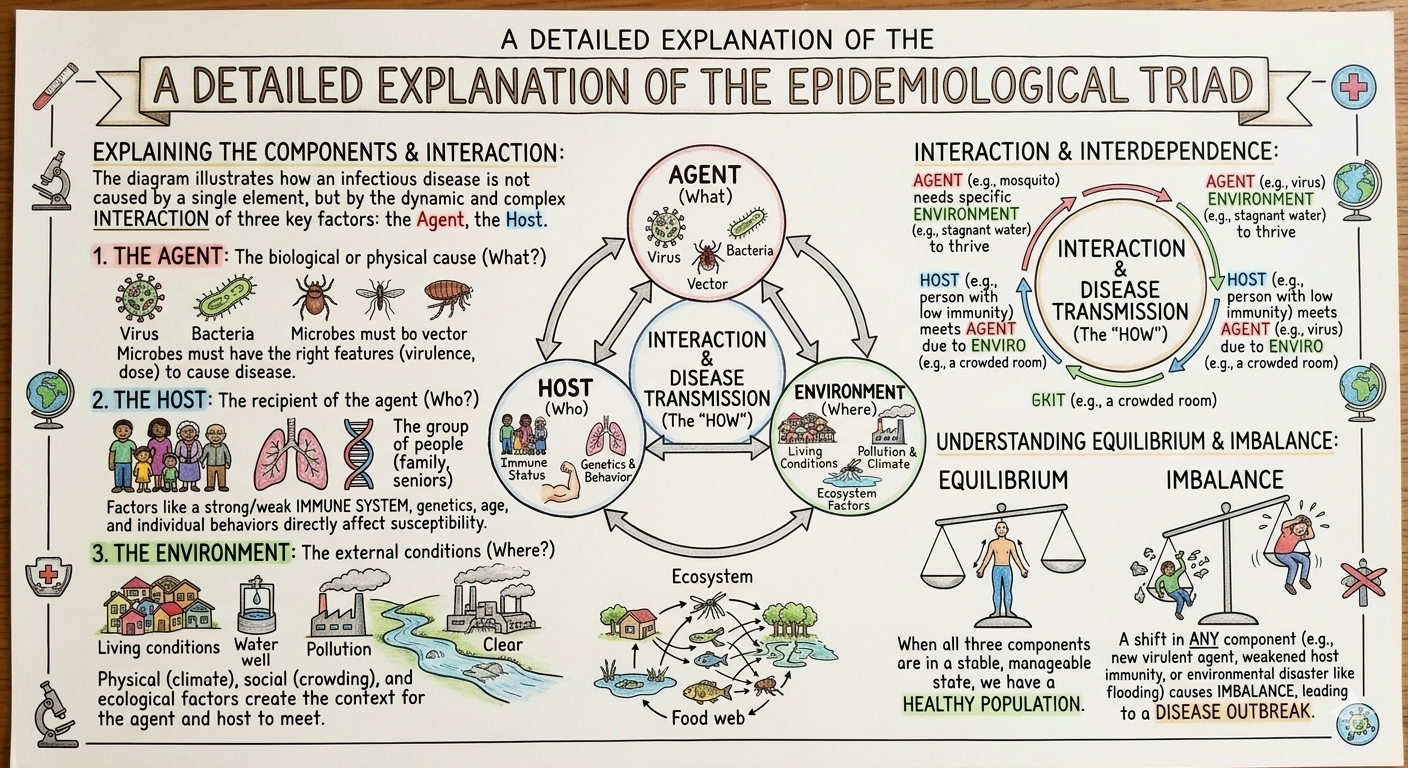
Epidemiological triad is also called as epidemiological triangle. It is a model developed by public health experts which explains how a disease spread into a specific area and people, explaining the causation and transmission of specifically infectious disease.
Why some people deveop disease and some not in the same community. To find out this one has to go beyond the agent bacteria and viruses. There epidemiological triad comes.
The core belief of the epidemiological triad is that, no disease can occur in the vaccume. Diseases always linked to the complex interaction between the three things, a agent, a susceptible host and the environment. If this three things allign properly, then only disease develops.
Three components of the epidemiological triad
- Agent
- Host
- Environment
Agent
Agent is causative microorganism. There are some types of agent given below,
- Biological agent – bacteria, viruses, and parasites
- Chemical agent – toxins, venom, heavy metals and chemical spills
- Physical agents – radiation, extreme heat, cold, physical trauma
Agent is required there to disease to occur. However, even though agent is present there is no garunteed that disease will developed. It needs host and environment factor also.
Host
Host is the person or animal to disease occur. Every one is differently susceptible to the infection as it depend on various factors mention below.
- Demographic factos such as age of person, old age and gender.
- Genetic pedisposition and immunity of person
- Diet, personal hygiene, occupation etc.
Above factors affect disease occurance rate. If the persons immunity is weak then even in low agent rate the disease can develops.
Environment
Environment connects the agent and host. It also serve as a important transmission agent for the bacterias. Enviroment includes,
- Physical environment – climate, weather, water quality and housing conditions etc.
- The presence of dust, mosquittoes, plants and animal reservoir in areas
- Overcrowding, poverty and sanitation
Environmental factors affect the growth of bacteria and also the transmission rate of the agent.
Time
Some epidemiologist place the time in centre of this triangle. This suppsed to be the how much time it will take to develop disease, appearance of symptoms and epidemiological timelines to develop disease when three parameters meet.
When the agent, host and environment are in good conditions the population remains healthy. and when one of factors if becomes changes then only a disease occurs. A disease outbreak occurs when any of changes occur are,
- Agent – becomes more powerful, contageious and resistant
- Host – Immunity of the person drops, so it can develop disease.
- Environmental changes – change in the climate, bacteria friendly environment promoting their growth and transmission.
How Epidemiological triad helps in controlling diseases?
The goal of triad is to find how disease is occuring, finding the weak link in the traingle. Then giving strong intervention to it and prevent it from occuring. Such as for agent developing an antibiotics, antiviral drugs etc. Protecting the host via vaccination, healthy diet and personal protective equipment. For environment control use water sanitation, spray, use of mosquitto repellent and social distancing in communicable diseases.
Related Posts